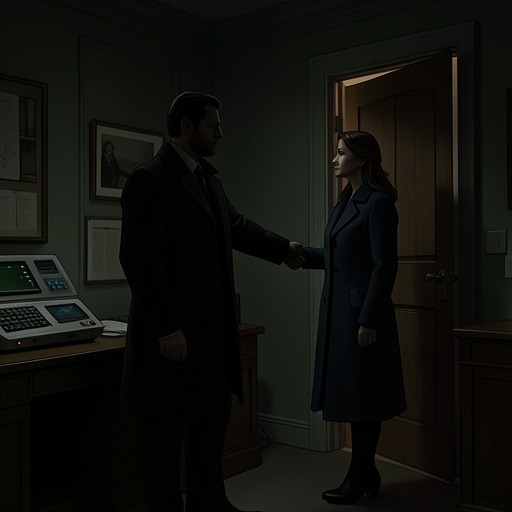
Senior Public Prosecutor Reimers
The Collini CaseSenior Public Prosecutor Reimers is the departmental head overseeing the prosecution of Fabrizio Collini. His role spans the investigation, the decision to bring a murder charge, and the courtroom proceedings. The case tests the difference between what the law permits and what satisfies his own need for an account that feels complete: Collini’s silence does not prevent a charge, but the absence of an intelligible motive leaves Reimers uneasy.
Position and Introduction
Reimers enters the case as a senior official whose involvement signals its importance within the prosecutor’s office. When Caspar Leinen arrives through the standby legal-aid roster, the magistrate explains that Reimers is coming in person despite it being the weekend, probably to receive a report. The remark establishes both his seniority and his direct attention to the matter before the investigation’s central uncertainty has been resolved.
Reimers is also present at the Forensic Institute when Leinen attends the autopsy, alongside two officers from the murder squad, waiting for Professor Wagenstett. A defense lawyer’s attendance is unusual, but Leinen wants to understand the case fully; the scene places Reimers among the officials assembling and assessing evidence, rather than apart from the practical work of the investigation.
The Investigation and the Decision to Charge
The investigation yields a starkly limited account. After six months, the authorities have a victim and a killer who has confessed, but no established motive or link between Collini and the victim. Searches of Collini’s apartment and examination of his finances uncover nothing suggesting murderous tendencies or financial disorder. An inquiry to the Italian police about the gun likewise produces no indication that it had previously been used in a crime. Collini also declines a psychiatric examination, leaving the investigators without that possible source of further information.
Reimers gives the murder squad as much time as he can. He knows that a small detail may sometimes explain a case, and his response is to wait and remain calm rather than treat the first account as complete. Here, however, the months bring no such discovery. The investigation stays where it began, and its unresolved question—why Collini acted—does not become an answer simply because the evidence establishes that he did it.
At last, Reimers rereads the file, writes his closing comment, and prepares the murder charge. He does not need a motive to charge Collini: a defendant may choose to say nothing, and cannot be forced to speak. The distinction is important to Reimers’s conduct. He recognizes the legal sufficiency of proceeding without an explanation even while disliking the loose ends and wanting to sleep at night confident that he has done the right thing.
His departure from the office gives that unease a concrete, procedural form. He places the files and charge in a wooden files box with separate compartments, where they are to be collected the next day. The charge will be stamped, sent through the regional court post room, and given a criminal-court reference number. Reimers has completed his work; the case will proceed through the institution, and is now outside his hands. Yet he feels uneasy on the way home. Administrative completion does not supply the certainty he wanted from the investigation.
Conduct at Trial
At the opening of the main hearing, Reimers stands to read the arraignment. The brief account takes hardly fifteen minutes. The presiding judge confirms that the district court has allowed the murder charge to proceed, then explains Collini’s right to remain silent at length. Reimers’s earlier recognition that silence cannot be compelled is thus carried into the public, formal setting of the trial: the prosecution proceeds, but the defendant’s refusal to explain remains protected.
Later, after Dr Schwan has given expert testimony, the presiding judge asks whether the prosecution has questions. Reimers shakes his head. His response is specific and restrained: at this point he has no questions for the expert witness. The scene does not establish why he declines to question her, so it cannot be treated as proof of agreement or indifference. It does show him participating in the trial without using every opportunity to speak.
Character and Narrative Significance
Reimers is defined by a tension between professional procedure and personal unease. He accepts that the law allows a murder charge without a disclosed motive and respects the defendant’s right to remain silent; at the same time, he wants the case to make sense beyond the threshold required to bring it to court. His concern is not presented as a reason to abandon the charge, but as a residue that remains after the formal steps are complete.
The movement from an investigation that finds no connection, to a charge that can nonetheless proceed, and then to the restrained exchanges in court makes Reimers a measure of the case’s unresolved quality. He waits for a detail that will explain everything, but none appears in the material described here. The file can be closed, transferred, and heard in court while the question that troubles him remains open. Through Reimers, the narrative distinguishes prosecutorial sufficiency from personal assurance without suggesting that either can substitute for the other.